
Calories in Common Foods: What a Real Portion Looks Like
Calories, protein, carbs and fat in rice, eggs, chicken, oats, potatoes, pasta, bread and more, per 100 g and per real portion, cooked and raw.
By Pierre Klasson · Last updated 7 November 2026 · Last reviewed 7 November 2026 · 20 min read
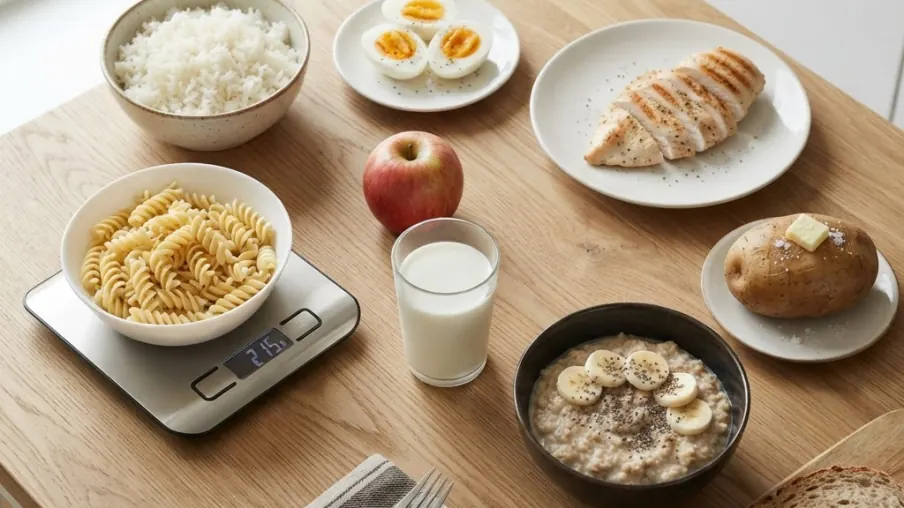
The first time I weighed a "normal" bowl of pasta, I was a little embarrassed. What I had been logging as one portion for months was closer to two. Nothing about the pasta was unusual. My idea of a portion was just off, and so was every number I had written down.
That's the problem this guide tries to fix. Calorie numbers for single foods are easy to find. What's harder is knowing what the number means for the amount actually on your plate, and how much it shifts when the food is cooked, fried, buttered or poured over cereal.
Below are the foods most of us eat every week: rice, eggs, chicken, oats, potatoes, pasta, bread, fruit, dairy and a few others. For each one I give the calories and macros per 100 g, what a typical portion weighs, and the cooking or serving choices that change the total the most.
How to Read the Numbers in This Guide
Every food below is listed per 100 g first, because that's how food databases and labels work, and it makes foods easy to compare. Then I give one or two realistic portions, because nobody eats exactly 100 g of anything on purpose.
All values are in kilocalories (kcal), which is what "calories" means on a label. If you see kilojoules, divide by about 4.2.
The macros follow the standard energy values that labels use:
- Protein: about 4 kcal per gram
- Carbohydrates: about 4 kcal per gram
- Fat: about 9 kcal per gram
- Alcohol: about 7 kcal per gram
These are known as Atwater factors, and the FAO still recommends them for food labelling. They're averages, though. In one well-known study, whole almonds turned out to deliver about 32% fewer calories than the Atwater factors predicted, because some of the fat stays locked inside the nut's cell walls and is never absorbed. That's an extreme case, but it's a useful reminder that any calorie number is an estimate.
If you'd like the basics explained in four minutes, this short lesson does it better than I could. It covers what a calorie actually measures and why the number on a label isn't always what your body gets.
Calories in Common Foods: Quick Reference Table
Here is the short version of everything below, for when you just need a number. The sections after it explain where each figure comes from and what changes it.
| Food | kcal per 100 g | Protein per 100 g | Typical portion | kcal per portion |
|---|---|---|---|---|
| White rice, cooked | 130 | 2.7 | 180 g bowl | 235 |
| Brown rice, cooked | 120 | 2.6 | 180 g bowl | 215 |
| Egg, large | 143 | 12.6 | 1 egg (50 g) | 72 |
| Chicken breast, cooked, skinless | 165 | 31 | 150 g | 250 |
| Chicken thigh, cooked, skinless | 195 | 25 | 120 g | 235 |
| Rolled oats, dry | 375 | 13 | 40 g | 150 |
| Potato, boiled | 87 | 1.9 | 200 g | 175 |
| Fries, deep-fried | 310 | 3.4 | 115 g (medium) | 355 |
| Pasta, cooked | 158 | 5.8 | 180 g (75 g dry) | 285 |
| White bread | 255 | 9 | 1 slice (35 g) | 90 |
| Banana | 89 | 1.1 | 1 medium (118 g) | 105 |
| Apple | 52 | 0.3 | 1 medium (180 g) | 95 |
| Semi-skimmed milk (per 100 ml) | 47 | 3.5 | 250 ml glass | 120 |
| Cheddar | 403 | 25 | 30 g | 120 |
| Salmon, farmed, cooked | 205 | 21 | 150 g fillet | 310 |
| Cod, cooked | 100 | 22 | 150 g fillet | 150 |
| Lentils, cooked | 115 | 9 | 150 g | 175 |
| Olive oil | 884 | 0 | 1 tbsp (13.5 g) | 120 |
If you want to know what your own daily target should be before you start adding things up, the calorie calculator in how to count calories from photos works it out from your age, height, weight and activity.
Raw vs Cooked: Why the Same Food Has Two Numbers
I got this wrong for months, and I still see friends do it, so it comes before the foods.
Cooking doesn't add or remove calories in any meaningful way (unless you add fat or drain it off). What it changes is water. Rice, pasta, oats and lentils soak up water and get heavier. Meat, fish and vegetables lose water and get lighter. Same calories, different weight.
That's why a food database might list rice at 360 kcal per 100 g and also at 130 kcal per 100 g. Both are correct. One is dry rice, the other is cooked.
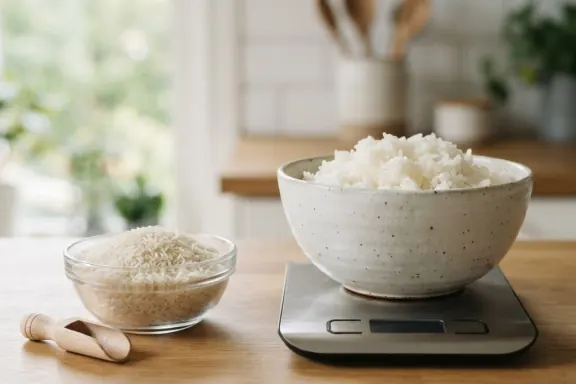
The rough ratios worth remembering:
- Rice: about 2.5 to 3 times heavier once cooked
- Pasta: a little over 2 times heavier
- Oats: depends entirely on how much liquid you use
- Chicken and other lean meat: around 25% lighter after cooking
- Mince: loses water and some fat, often 25 to 30% lighter
The mistake isn't choosing raw or cooked. It's mixing them up. If you weigh 200 g of cooked rice and log 200 g of uncooked rice, you've just counted about 720 kcal for a portion that's really about 260. Do it the other way round and you undercount by the same amount.
Calories in Rice: Cooked, Uncooked and Fried
Cooked white rice: about 130 kcal per 100 g, with 2.7 g protein, 28 g carbohydrates and 0.3 g fat.
Uncooked white rice: about 360 kcal per 100 g.
Cooked brown rice: about 110 to 125 kcal per 100 g, with a little more fibre (around 1.5 to 2 g per 100 g compared with under 1 g for white).
A typical portion is 150 to 200 g cooked, which is about 75 g dry. That's roughly 200 to 260 kcal. A generous restaurant portion, or a takeaway box, is often 300 g or more, so 400 kcal before anything goes on top.
Brown rice is a little lower per 100 g cooked mostly because it holds slightly more water. Per dry gram, the two are almost identical. The real difference is fibre and how full it keeps you, not the calories.
Where rice gets expensive is the preparation. Egg-fried rice from a takeaway can easily be 180 to 200 kcal per 100 g because of the oil. Pilau and biryani sit somewhere in between, depending on how much ghee or oil goes in. If I'm logging a takeaway, I log it as fried rice even if it looks plain, because it almost always has more fat than I'd guess.
Calories in an Egg: Boiled, Fried and Scrambled
One large egg (about 50 g without the shell): about 72 kcal, 6.3 g protein, 4.8 g fat and almost no carbs.
Per 100 g: about 143 kcal.
A medium egg is closer to 44 g and about 63 kcal. A very large one can be 60 g or more and over 85 kcal. For most purposes, 70 kcal per egg is a good working number.
Boiled and poached eggs are the same as raw. The changes come from what you cook them in:
- Fried in a teaspoon of oil or butter: add about 35 to 40 kcal
- Scrambled with a splash of milk and a knob of butter: two eggs often come to 200 to 250 kcal
- Omelette with cheese: a two-egg omelette with 30 g of cheddar is around 300 kcal before any oil
The yolk holds nearly all the fat. A large egg white alone is about 17 kcal with 3.6 g of protein. I just eat whole eggs: two give you about 12 g of protein for under 150 kcal.
Chicken Breast vs Thigh: Calories and Protein
Cooked skinless chicken breast: about 165 kcal per 100 g, with 31 g protein and 3.6 g fat.
Raw skinless chicken breast: about 120 kcal per 100 g, with 22 to 23 g protein.
Cooked skinless chicken thigh: about 180 to 210 kcal per 100 g, with 24 to 26 g protein.
Roast chicken with skin: around 220 to 250 kcal per 100 g, depending on the cut.
A whole chicken breast fillet usually weighs 150 to 220 g raw, which comes to about 120 to 170 g once cooked. That's roughly 200 to 280 kcal and 37 to 52 g of protein. That's why chicken breast turns up in pretty much every muscle-building meal plan.
Thighs have a bit more fat, which is why they stay juicy. A 120 g cooked portion is only about 40 to 50 kcal more than breast. I cook thighs most weeks because they taste better, and I'm happy to pay those 50 kcal.
The skin is where most of the fat lives. Leaving it on a roast chicken leg can add 50 to 80 kcal. And the cooking oil matters more than the cut. A tablespoon of olive oil is about 120 kcal, so chicken breast pan-fried in a generous glug of oil can end up with more calories from the pan than from the chicken.
If you're working out how much protein you need each day, the calculator in how to gain muscle gives you a range based on your weight and goal.
Oats and Porridge: How Milk and Toppings Change the Total
Dry rolled oats: about 375 to 380 kcal per 100 g, with 13 g protein, 60 to 66 g carbohydrates, 7 g fat and around 10 g fibre.
A standard portion is 40 g, which is about 150 kcal. That's half a cup if you use cups. Plenty of people pour closer to 60 or 70 g without noticing, which is 230 to 270 kcal before anything else goes in.
What you cook them in changes the total a lot:
- Made with water: about 150 kcal for 40 g
- With 250 ml skimmed milk: about 235 kcal
- With 250 ml semi-skimmed milk: about 270 kcal
- With 250 ml whole milk: about 310 kcal
- With 250 ml unsweetened oat drink: roughly 250 to 270 kcal, depending on the brand
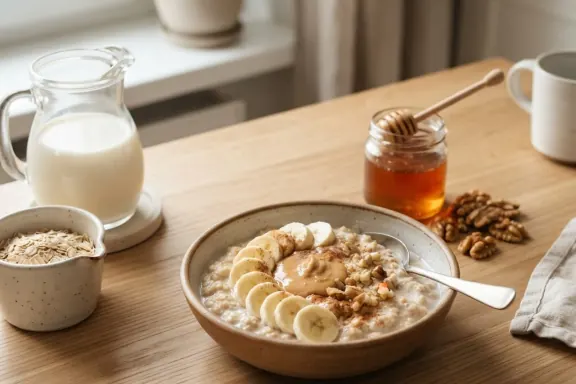
Then the toppings. A medium banana adds about 105 kcal. A teaspoon of honey adds about 20, a tablespoon around 60. A tablespoon of peanut butter is about 95. A small handful (15 g) of walnuts is about 100.
None of this is a reason to avoid porridge, which is one of the most filling breakfasts there is. It just shows how a "150 kcal" food becomes a 500 kcal breakfast. My own usual bowl is 50 g of oats, semi-skimmed milk, half a banana and a spoon of peanut butter, and it comes to about 450 kcal. I'd have guessed 300.
Overnight oats work the same way. The oats don't change. The yoghurt, milk and seeds you add do.
Potatoes: Boiled, Baked, Roasted or Fried
Boiled potato (no skin): about 87 kcal per 100 g.
Baked potato with skin: about 93 kcal per 100 g.
Mashed potato with milk and butter: about 105 to 120 kcal per 100 g.
Roast potatoes: around 140 to 160 kcal per 100 g, depending on the oil.
Oven chips: around 160 to 200 kcal per 100 g.
Deep-fried chips or fries: around 300 to 320 kcal per 100 g.

With potatoes, how you cook them matters more than the potato itself. A plain potato is mostly water and starch and very filling. Fry it and you roughly triple the energy per gram, mostly from absorbed oil.
A medium baking potato is about 200 to 250 g, so roughly 190 to 230 kcal plain. Add 10 g of butter (about 75 kcal) and 30 g of grated cheese (about 120 kcal) and it's around 400. Still a reasonable dinner. Just not the 200 kcal you might log if you only counted the potato.
A medium portion of fast-food fries is often 110 to 120 g, which puts it around 340 to 380 kcal. A large can be well over 450.
Sweet potatoes are about 86 to 90 kcal per 100 g baked. More fibre and vitamin A, but not a lower-calorie swap.
Pasta Calories: Dry vs Cooked, and Real Portions
Cooked pasta: about 155 to 160 kcal per 100 g, with 5.5 to 6 g protein and 30 to 31 g carbohydrates.
Dry pasta: about 350 to 370 kcal per 100 g.
Cooked wholewheat pasta: about 140 to 150 kcal per 100 g, with more fibre.
The usual "one portion" on packets is 75 g dry, which is about 170 to 180 g cooked and around 270 kcal. That's the amount I mentioned at the start. When I actually weighed what I was serving myself, it was about 130 g dry, or close to 470 kcal before the sauce. It was an honest mistake. A 75 g portion just looks small in a big bowl.
Fresh egg pasta is a bit different. It's sold already moist, so per 100 g as sold it's about 270 to 290 kcal, and it gains less weight when you cook it.
The sauce often matters as much as the pasta. A tomato-based sauce might add 60 to 100 kcal per portion. A pesto, carbonara or cream sauce can add 250 to 400. I compared the numbers for 101 sauces and condiments in sauce nutrition compared, and pasta sauces were where the range was widest.
Bread, Bagels and Crispbread: Calories per Slice
White bread: about 250 to 265 kcal per 100 g.
Wholemeal bread: about 230 to 250 kcal per 100 g, with more fibre.
Sourdough: about 230 to 270 kcal per 100 g, depending on the flour.
Crispbread (knäckebröd): about 330 to 370 kcal per 100 g, but each slice is light.
A slice of sandwich bread is usually 30 to 40 g, so roughly 75 to 100 kcal. A thick slice from a bakery loaf can easily be 50 to 60 g and close to 150 kcal. Bagels are dense: a plain one is often 90 to 110 g and 250 to 280 kcal, about the same as three slices of bread.
Crispbread looks high per 100 g because it has almost no water, but a slice is only 10 to 15 g, so 35 to 50 kcal.
As with potatoes, the bread is rarely the problem. The butter is. A scrape of butter is about 5 g and 35 kcal. A generous spread on toast can be 10 to 15 g and 75 to 110 kcal per slice. Two slices of buttered toast with jam can come to 350 kcal without looking like a big breakfast.
Fruit, Dried Fruit and Juice
Fruit is the easy part. Most whole fruit is 40 to 90 kcal per 100 g, high in water and fibre, and hard to overeat. A few common ones:
- Banana, medium (about 118 g peeled): about 105 kcal
- Apple, medium (about 180 g): about 95 kcal
- Orange, medium (about 130 g): about 60 kcal
- Grapes: about 70 kcal per 100 g, so a 150 g bowl is about 105
- Strawberries: about 32 kcal per 100 g
- Blueberries: about 57 kcal per 100 g
- Avocado: about 160 kcal per 100 g, so half a medium one is about 110 to 120
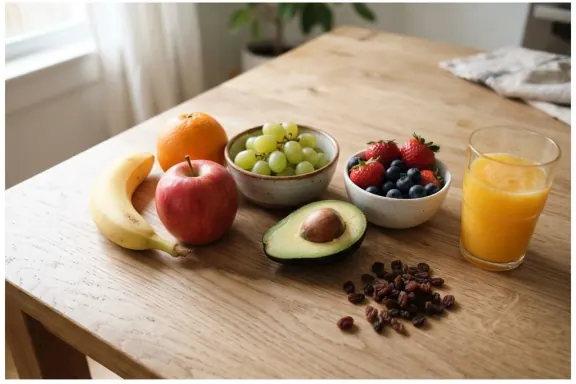
Avocado doesn't fit the pattern, because it's mostly fat. It's a good food, but half an avocado has about as many calories as a whole bowl of strawberries and blueberries.
Dried fruit and juice are where fruit calories climb. Removing the water concentrates the sugar: raisins are around 300 kcal per 100 g, and a small box is about 40 g and 120 kcal. A 250 ml glass of orange juice is about 110 to 120 kcal, roughly the same as two oranges, but without the fibre that would have made you feel full.
Milk, Yoghurt and Cheese
Milk per 100 ml:
- Skimmed (0.1 to 0.5%): about 35 kcal
- Semi-skimmed (1.5 to 1.8%): about 46 to 50 kcal
- Whole (3 to 3.5%): about 61 to 64 kcal
A 250 ml glass is 85, 120 or 160 kcal depending on the type. Milk in tea is small, around 10 to 20 kcal a cup. Milk in coffee drinks is not. A medium latte made with whole milk is often 180 to 220 kcal, with semi-skimmed around 140 to 160, and with skimmed closer to 100 to 120. Two lattes a day is easily 300 to 400 kcal that rarely makes it into a food log.
Yoghurt per 100 g:
- Plain fat-free Greek-style or skyr: about 55 to 65 kcal, with 9 to 11 g protein
- Plain whole-milk yoghurt: about 60 to 75 kcal
- Full-fat Greek yoghurt (around 10% fat): about 120 to 135 kcal
- Flavoured fruit yoghurt: often 85 to 110 kcal, with added sugar
Cheese per 30 g portion:
- Cheddar or similar hard cheese: about 120 kcal
- Mozzarella: about 75 to 85 kcal
- Feta: about 75 to 80 kcal
- Cottage cheese: about 25 to 30 kcal
A 30 g portion of cheddar is about the size of a matchbox, which is smaller than most people cut. Grated cheese is easy to pile on. A loose handful on pasta is often 40 to 50 g, or 160 to 200 kcal.
Meat, Fish and Plant Proteins
A few more you're likely to eat, all cooked unless stated:
- Salmon (farmed): about 200 to 210 kcal per 100 g, with 20 to 22 g protein. Wild salmon is leaner, closer to 140 to 180.
- Cod or other white fish: about 95 to 105 kcal per 100 g, with 20 to 23 g protein.
- Tuna canned in water, drained: about 110 to 120 kcal per 100 g, with 25 g protein. Canned in oil and drained, nearer 190.
- Beef mince, 5% fat: about 170 to 190 kcal per 100 g cooked.
- Beef mince, 20% fat: about 250 to 280 kcal per 100 g cooked, less if you drain the fat.
- Lentils: about 115 kcal per 100 g, with 9 g protein and 8 g fibre.
- Chickpeas: about 140 to 165 kcal per 100 g, depending on the source.
- Firm tofu: about 120 to 145 kcal per 100 g, with 12 to 15 g protein.
With mince, the label matters most. Going from 5% to 20% fat adds 80 to 100 kcal per 100 g, so a 500 g family bolognese gains 400 to 500 kcal just from the pack you picked. And a 150 g salmon fillet is about 300 kcal, roughly double the same weight of cod.
Oil, Butter and Other Extras
After a few weeks of tracking, I noticed my logs rarely went wrong on the rice or the chicken. They went wrong on the extras. These are the ones I see most often:
- Olive oil or other cooking oil: about 120 kcal per tablespoon, 40 per teaspoon
- Butter: about 75 kcal per 10 g
- Peanut butter: about 95 kcal per tablespoon (16 g)
- Mayonnaise: about 95 to 100 kcal per tablespoon
- Sugar: about 16 kcal per teaspoon
- Honey: about 20 kcal per teaspoon
- A splash of milk in tea or coffee: about 10 to 20 kcal
- A 150 ml glass of 12% wine: about 120 kcal
- A pint (568 ml) of 4% beer: about 180 to 200 kcal
The oil is the big one. Most people pour cooking oil straight from the bottle, and "a bit of oil" is often two or three tablespoons. That's 240 to 360 kcal in the pan, usually split between two or three portions, and usually not logged at all.
I measured oil with a spoon for a couple of weeks to train my eye. Now I know what a tablespoon looks like in my pan.
Five of My Everyday Meals, Weighed
Nobody eats a single food on its own, so here are five meals I make a lot, broken down part by part. I weighed them at home, so yours will be different. What I wanted to see was where the calories actually come from.
Porridge breakfast: 50 g oats (about 190), 250 ml semi-skimmed milk (120), half a banana (55), a tablespoon of peanut butter (95). About 460 kcal and 20 g protein.
Eggs on toast: two large eggs fried in a teaspoon of butter (about 180), two slices of wholemeal bread (180), a scrape of butter on each (70). About 430 kcal and 22 g protein.
Chicken and rice: 150 g cooked chicken breast (about 250), 180 g cooked rice (235), a tablespoon of oil for cooking (120), mixed vegetables (40). About 645 kcal and 52 g protein. Without the oil, 525.
Pasta with tomato sauce: 100 g dry pasta (about 355), a homemade tomato sauce with a tablespoon of olive oil (around 170 for my share), 20 g grated parmesan (80). About 605 kcal and 22 g protein.
Baked potato dinner: a 250 g potato (230), 10 g butter (75), 100 g tuna in water mixed with a tablespoon of light mayonnaise (about 160), side salad without dressing (20). About 485 kcal and 30 g protein.
In these five, the oil, butter, milk, cheese and toppings came to anywhere from a fifth to more than half of the total. Those are exactly the parts I used to leave out.
🍽️ Meal calorie estimator
Pick foods and enter portions in grams to see how each choice changes the total.
1 breast ≈ 150 g · 248 kcal
1 cup ≈ 180 g · 234 kcal
1 cup ≈ 100 g · 35 kcal
1 tbsp ≈ 14 g · 124 kcal
≈ 641 kcal estimated meal total
Rounded average values per 100 g, based on USDA FoodData Central. Real foods vary by brand and cooking method. This is an illustration, not a measure of any app's scan accuracy.
Why Labels and Databases Don't Always Agree
If you look up the same food in three apps, you'll often get three slightly different numbers. That doesn't mean any of them is wrong.
Databases measure samples, and real food varies. One batch of chicken is leaner than another, two brands of bread use different flour, and the water in "cooked rice" depends on the grain and the pot.
Labels have their own tolerances. Manufacturers usually calculate the energy from the macronutrients using the standard factors, and most countries accept some margin either side. Restaurant numbers can be further off. A 2011 study in JAMA tested 269 restaurant foods in a laboratory and found the stated calories were accurate on average, but about one in five items had at least 100 kcal more than stated. Foods with lower stated calories were the ones most likely to be underestimated.
So don't agonise over whether your rice is 128 or 133 kcal per 100 g. That's noise. Getting the portion roughly right, and not missing the oil or the latte, matters far more.
How I'd Use These Numbers Day to Day
You don't need to memorise any of this. A few habits get you most of the way:
Weigh your usual portions once. Spend a week weighing the things you eat most often: your normal bowl of cereal, your rice portion, your pasta, the cheese you cut. You'll probably find one or two that are much bigger than you thought. After that, you can mostly go by eye.
Match raw with raw and cooked with cooked. When you pick an entry in an app, check whether it says cooked or raw, dry or prepared. Most of my own early mistakes came down to this.
Count the fat you cook with. If oil, butter or cream went into the pan, log it. Split it across portions if you're cooking for more than one.
Log drinks. Milky coffees, juice, smoothies and alcohol often come to 200 to 500 kcal a day for people who don't think of themselves as big drinkers.
Think in weekly averages. A single day's total is rarely exact. Over a week, the small errors in one direction or the other tend to even out, and the trend is what tells you whether your intake matches your goal.
If you'd rather not count at all, the NHS Eatwell Guide and the USDA's MyPlate show how to balance food groups without numbers.
How Navilo Health Handles This
I build Navilo Health, so take this with that in mind. When you photograph a meal or say what you ate, the app lists each food with an estimated portion in grams, plus its calories and macros. The part I'd encourage you to check is the portion, because that's where most estimates go wrong, the same way my pasta did.
No photo can see the oil in a pan, so add it if you used some. You can also save meals you eat often, like your usual porridge, so the corrected version is one tap away next time.
Who Should Be Careful With Calorie Numbers

These numbers are meant to help you understand your food, not to make every meal feel like a maths test. If counting calories makes you anxious, guilty or obsessive, or if you have a history of disordered eating, please talk to your doctor or a specialist before you start. There are other ways to eat well that don't involve numbers.
If you have diabetes, kidney disease, are pregnant or breastfeeding, or take medication that affects your appetite or blood sugar, talk to your doctor or a dietitian before making big changes to what you eat. The same goes for children and teenagers, whose needs are different from adults.
Quick Recap
The numbers for most everyday foods are easy to remember. Cooked rice is about 130 kcal per 100 g, an egg is about 70, cooked chicken breast about 165 per 100 g, a 40 g bowl of oats about 150 before milk, and a plain potato under 100 per 100 g. Where the numbers swing is in the cooking and the extras: oil, butter, milk, cheese and sauce.
Weigh your usual portions once, pick cooked entries for cooked food, and log the fat you cook with. Those three habits did more for my numbers than any database ever did.
Frequently asked questions
How many calories are in 100 g of cooked rice?
Cooked white rice is about 130 kcal per 100 g, with about 28 g of carbs and under 3 g of protein. Uncooked rice is about 360 kcal per 100 g. The difference is water: rice roughly triples in weight when it cooks, so the calories are spread over more grams.
How many calories are in an egg?
A large egg (about 50 g without the shell) has about 72 kcal, 6 g of protein and 5 g of fat. Boiled or poached it stays the same. Fried in a teaspoon of butter or oil it lands closer to 110 kcal.
Should I weigh food raw or cooked?
Either works, as long as the database entry matches what you weighed. Raw is more consistent because cooked weight depends on how long you cooked it and how much water it soaked up or lost. The common mistake is weighing cooked food and logging the raw entry, or the other way round.
How many calories are in chicken breast?
Cooked skinless chicken breast is about 165 kcal per 100 g with about 31 g of protein. Raw it is about 120 kcal per 100 g. A typical cooked breast weighs 120 to 170 g, so roughly 200 to 280 kcal before any oil or sauce.
How many calories are in a bowl of porridge?
A 40 g portion of dry oats is about 150 kcal. Made with water it stays there. With 250 ml of semi-skimmed milk it is about 270 kcal, and with whole milk closer to 310. A banana adds about 105 and a teaspoon of honey about 20.
Are calorie numbers on labels exact?
No. They are averages, and most countries allow a margin of error. A 2011 study of restaurant meals found stated calories were right on average, but about one in five items had at least 100 kcal more than listed. Treat every number as a close estimate, not a measurement.
Sources
- U.S. Department of Agriculture, Agricultural Research Service. FoodData Central. USDA, accessed November 2026.
- Livsmedelsverket (Swedish Food Agency). Livsmedelsdatabasen (Food composition database). Livsmedelsverket, accessed November 2026.
- Food and Agriculture Organization of the United Nations. Food energy: methods of analysis and conversion factors. FAO Food and Nutrition Paper 77, 2003.
- Urban LE, McCrory MA, Dallal GE, et al. Accuracy of stated energy contents of restaurant foods. JAMA, July 2011.
- Novotny JA, Gebauer SK, Baer DJ. Discrepancy between the Atwater factor predicted and empirically measured energy values of almonds in human diets. American Journal of Clinical Nutrition, August 2012.
- NHS. The Eatwell Guide. NHS, accessed November 2026.
- U.S. Department of Agriculture. MyPlate. USDA, accessed November 2026.
Spotted a mistake or an out-of-date number? Tell me and I'll check it.
Report an errorThis article is general information, not medical advice. Talk to a doctor before big changes to your diet or training.
Know someone who'd like this one?
Keep reading
Nutrition
How to Count Calories From Photos (and Pair It With a Calorie Calculator)
How photo calorie counting really works, how accurate it is, and how to combine it with a calorie calculator so the numbers actually mean something.
Nutrition
Sauce Nutrition Compared: Fat, Sugar and Salt per 100 g
Mayo has about 75 g of fat per 100 g, ketchup almost none. Compare fat, sugar, salt and calories in 101 sauces, from pesto to Chick-fil-A sauce.

Training
How to Gain Muscle: The Complete Guide to Building Muscle
How muscle actually grows, and the training, food and sleep habits that make it happen, explained without the gym-bro myths.
Keep reading
More guides in the same topic.