
Nutrition
How to Count Calories From Photos (and Pair It With a Calorie Calculator)
How photo calorie counting really works, how accurate it is, and how to combine it with a calorie calculator so the numbers actually mean something.
By Pierre Klasson · Last updated 15 October 2026 · 17 min read
Most people who try counting calories stop within a few weeks. Guessing portions is unreliable, and weighing every meal on a kitchen scale is tedious.
Photo counting sits in between. You photograph your plate, an app estimates what's on it, and you correct anything that looks wrong. It's less precise than a scale, but much quicker.
But a photo only tells you what you ate. It doesn't tell you whether that's too much or too little. For that you need a calorie calculator to work out your own daily target. Below I cover both: how photo counting works, how accurate it is, how to take better photos, and how to set a target.
What Is a Calorie?
A calorie is a unit of energy. On food labels, "calories" really means kilocalories (kcal): the energy needed to warm one litre of water by one degree Celsius. In Europe you'll often see kilojoules (kJ) next to it. One kcal is about 4.2 kJ.
Your body gets that energy from three macronutrients, plus alcohol:
- Protein: about 4 kcal per gram
- Carbohydrates: about 4 kcal per gram
- Fat: about 9 kcal per gram
- Alcohol: about 7 kcal per gram

That's why fatty foods add up so fast. A gram of oil has more than twice the energy of a gram of sugar or chicken. Water and most fibre have no usable calories, which is why vegetables and soups are filling without much energy.
Your body uses calories for everything: keeping you alive at rest, digesting food, and moving. If you take in more than you use over time, the extra is stored, mostly as fat. If you take in less, your body draws on its stores. That balance is the whole reason counting calories works.
Why Counting Calories Is Harder Than It Sounds
On paper it's just adding up. In practice, most of us are bad at it.
A well-known 1992 study looked at a small group of people with obesity who said they couldn't lose weight despite eating very little. When the researchers measured what they actually ate and burned, the participants had underreported their food intake by around 47 percent and overreported their exercise by about 51 percent. That was one specific group, so the exact numbers don't apply to everyone. But later research keeps finding the same pattern: when people report what they eat, the total usually comes out too low.
Most of the errors come from a few places:
- Portion size. A "bowl of pasta" can be 300 calories or 900, depending on the bowl.
- Cooking fat. Oil and butter add a lot of energy and are almost invisible once food is cooked. One tablespoon of oil is around 120 calories.
- Forgotten bites. The handful of nuts, the kids' leftover fish fingers, the milk in three coffees.
- Drinks. Juice, beer, wine, lattes and smoothies rarely feel like "food".
- Weekends. Plenty of people track carefully Monday to Thursday and then stop.
So anything that makes logging easier and catches more of what you eat helps.
What Is a Calorie Calculator, and Why You Need One First
A calorie calculator estimates how many calories your body uses in a normal day. It usually works in two steps. First it estimates your resting energy use, the calories you'd burn lying on the sofa all day just keeping your heart beating, your brain running and your body warm. Then it multiplies that by an activity factor to account for walking, working, training and everything else you do.
The most widely used formula for the first step is the Mifflin-St Jeor equation. Researchers tested it against measured energy use and found it to be one of the more accurate options for most adults:
- Men: 10 × weight (kg) + 6.25 × height (cm) − 5 × age + 5
- Women: 10 × weight (kg) + 6.25 × height (cm) − 5 × age − 161
The activity multipliers most calculators use look roughly like this:
- 1.2 if you mostly sit, with little exercise
- 1.375 for light activity, a bit of walking or exercise 1 to 3 days a week
- 1.55 for moderate activity, exercise most days
- 1.725 if you're very active, hard training 6 to 7 days a week
- 1.9 for athletes or physically demanding jobs
The result is your estimated maintenance calories, the amount that should keep your weight roughly stable. If you want to lose weight, you eat a bit below it. If you want to gain muscle, a bit above.
An example: a 35-year-old woman, 168 cm tall, 72 kg, with a desk job and three gym sessions a week. Her resting estimate is 10 × 72 + 6.25 × 168 − 5 × 35 − 161 = 1,434 calories. Multiply by 1.375 for light activity and you get about 1,970 calories a day to maintain her weight. A modest deficit for weight loss might put her target somewhere around 1,500 to 1,700.
You can try it yourself below. It takes about 30 seconds.
🔥 Calorie needs calculator
2590 kcal per day to maintain
- Too aggressiveUnder 2090 kcal
Hard to stick to, and you risk losing muscle, energy and nutrients.
- Fat loss2090 – 2290 kcal
A steady deficit of 300–500 kcal: roughly 0.25–0.5 kg a week.
- Maintain2590 kcal
Keeps your weight stable at your current activity level.
- Lean muscle gain2840 – 3090 kcal
A small surplus to build muscle with minimal fat gain.
An estimate, usually within about 10%. Track your weight for 2–3 weeks and adjust. Not for pregnancy or under-18s.
If you eat your "maintenance" number for three weeks and slowly gain weight, your real maintenance is lower than the formula said. Trust your scale's trend over the formula.
Other formulas you'll come across
Mifflin-St Jeor isn't the only option. Two others show up on a lot of calculators:
- Revised Harris-Benedict (1984): men 13.397 × weight + 4.799 × height − 5.677 × age + 88.362, women 9.247 × weight + 3.098 × height − 4.330 × age + 447.593. It's older and tends to come out a little high for many people.
- Katch-McArdle: 370 + 21.6 × lean body mass (kg). Lean mass is your weight minus your fat, so you need a body fat estimate first. If you're fairly lean and know your body fat percentage, this one can be closer than the others, because muscle burns more energy than fat.
In practice the three usually land within 100 to 200 calories of each other. Pick one, stick with it, and let your weight trend do the correcting.
The "3,500 calories per pound" rule
You'll often read that a pound of fat (about 0.45 kg) holds roughly 3,500 calories, so eating 500 less a day loses a pound a week. As a rough starting point, that's fine. Over months it overpromises. A 2008 analysis by NIH researcher Kevin Hall showed the real energy cost per kilo lost isn't a fixed number, and as you lose weight you burn less, so the same deficit gets smaller over time and weight loss slows. That's one reason the NIH's Body Weight Planner, mentioned further down, predicts a curve rather than a straight line.
How big a deficit is safe?
I wouldn't go more than about 500 to 1,000 calories below maintenance, or roughly 0.5 to 1 kg a week. The CDC also describes gradual loss of about 0.5 to 1 kg (1 to 2 pounds) a week as the pace people are more likely to keep off. Faster than that, more of what you lose tends to be muscle and water, hunger gets much harder to manage, and the weight is more likely to come back. If you want to lose faster than that, do it with your doctor or a dietitian.
Calorie cycling
You don't have to eat exactly the same amount every day. Some people eat a bit more on training days or weekends and a bit less on other days, as long as the weekly total lands where it should. A 1,700 target becomes 11,900 for the week, and you can split it however suits your life. For many people that's easier to stick with than the same number every day.
Not all calories fill you up the same
200 calories of soft drink and 200 calories of chicken and vegetables count the same on paper, but they don't feel the same. Drinks, sweets and highly processed snacks are easy to eat a lot of without feeling full. Protein, fibre and foods with a lot of water in them (vegetables, fruit, soups) keep you full for longer. If you're always hungry on your target, change what you eat before you change the number.
With a target set, your logged meals have something to be compared against.
How Counting Calories From Photos Actually Works
When you photograph your plate, the app does roughly four things in a couple of seconds.
1. It works out what the foods are. The app looks at the image and identifies the individual items. Salmon, roast potatoes, salad, a lemon wedge. This part usually works well, even for home cooking.
2. It estimates how much of each food there is. This is the harder part. A photo is flat, so the app uses visual clues to guess size: the plate, the cutlery, how high the food is piled, how much of the plate it covers. It turns that into an estimated weight or a familiar portion, like "about 150 g of salmon" or "one medium potato".
3. It looks up the nutrition. With a food and a weight, it can work out calories, protein, carbs and fat from nutrition data. Large public databases such as the USDA's FoodData Central hold detailed values for thousands of foods, and many apps draw on data like this.
4. It shows you the result to check. You should be able to change portions, delete wrong items and add missing ones. If an app doesn't let you do that, I wouldn't use it.
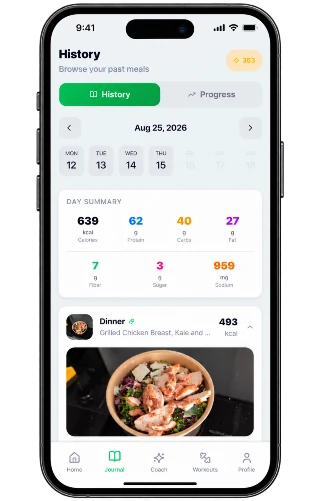 A day in Navilo Health: one photo of dinner becomes calories, macros, fibre, sugar and sodium, added to the day's total.
How Accurate Are Photo Calorie Estimates?
It depends a lot on the meal.
The research is still young. A 2023 review of 52 studies on AI photo estimates found average calorie errors ranging from under 1 percent to about 38 percent, depending on the system and the food. Errors were smallest for images of single or simple foods. A 2020 meta-analysis of photo-based food diaries found they tended to underestimate intake, much like written diaries do.
So for simple plates with clearly separated foods, expect estimates to be fairly close. A chicken breast, a pile of rice and some broccoli is easy. You can see everything, the shapes are familiar, and there's not much hiding.
Accuracy drops when calories are hidden. Think lasagne, curry, a burrito, a creamy pasta bake or a salad soaked in dressing. The app can see the dish but not exactly what went into it. Two lasagnes that look identical can differ by several hundred calories depending on how much cheese and mince the cook used.
Here's how I'd roughly rank meals from easiest to hardest:
- Easiest: single whole foods, like a banana, an apple or a boiled egg
- Easy: separated plates, like meat or fish with a side and vegetables
- Medium: sandwiches, bowls and simple salads where you can still see most of the parts
- Harder: mixed dishes like stir-fries, pasta with sauce and casseroles
- Hardest: soups, smoothies, stews, anything fried and restaurant food cooked with unknown amounts of butter
Is that good enough? For everyday tracking, usually yes, as long as you check the results. The 2023 review concluded AI estimates were roughly in line with human estimates, but not yet reliable enough to use unchecked. Your own five-second review is what closes the gap.
You also know things the camera doesn't: that you fried the eggs in butter, that the "yogurt" is the full-fat Greek one, and that you had two slices of bread, not one. A five-second check before saving fixes most big errors.
How to Take Food Photos That Give Better Estimates
Better photos give better estimates. A few habits help.
Shoot from above, at a slight angle. A straight top-down shot shows everything on the plate. Tilting the phone a little, maybe 30 to 45 degrees, also shows how high the food is piled, which helps with portion size. A side-on shot hides half the plate.
Get the whole plate in the frame. The edge of the plate is one of the best clues for scale. If you crop too tight, the app has less to go on. If you include a fork or knife, even better, since those are fairly standard sizes.
Use decent light. Daylight from a window is ideal. Dim restaurant lighting and strong yellow kitchen lights can make foods harder to tell apart. Avoid harsh shadows over half the plate.
Spread things out a bit. If the rice is buried under the curry, the app can't see how much rice there is. Nudging items apart a little is enough.
Take the photo before you eat. Half-eaten plates are much harder to estimate.
One plate per photo. If you have a main and a side bowl, either fit both in one shot or log them separately. Don't let the side dish disappear off the edge.
Photograph drinks too. A glass of orange juice or a latte can be 100 to 250 calories. They count.
Watch Out for Hidden Calories
Some calories never show up in a photo.
Cooking oil and butter. A tablespoon of olive oil is around 120 calories, and a tablespoon of butter about 100. Roasted vegetables, fried eggs, sautéed anything and most restaurant food will have some. If you cooked with fat, add it.
Dressings and sauces. Two tablespoons of a creamy salad dressing can add 150 calories or more. Mayonnaise, pesto, aioli and peanut sauce are all calorie-dense. A salad can easily have more calories in its dressing than in everything else combined.
Cheese. Grated cheese melted into a dish, or sprinkled on top, is easy to underestimate. 30 g of cheddar is roughly 120 calories, and it's surprisingly easy to use double that.
Nuts and seeds. Healthy, but energy-dense. A small handful of almonds is around 160 to 170 calories.
Drinks and milk. Milk in coffee and tea adds up over a day. Alcohol is around 7 calories per gram, and a large glass of wine can be 200 calories or more.
The bits you don't plate. Tasting while cooking, finishing the kids' food, the biscuit with your coffee. None of it is in the photo.
My rule: if I cooked with oil or butter, I add a tablespoon unless I know I used less. Not precise, but closer than adding nothing.
Use the table below to see which foods pack the most calories, per 100 g and per typical portion. Sort by portion to see which everyday servings add up fastest.
🔥 High-calorie food database
| Food | kcal / 100 g | Typical portion |
|---|---|---|
| Olive oilFats & oils | 884 | 124 kcal1 tbsp (14 g) |
| Rapeseed / canola oilFats & oils | 884 | 124 kcal1 tbsp (14 g) |
| Coconut oilFats & oils | 862 | 121 kcal1 tbsp (14 g) |
| Macadamia nutsNuts & seeds | 718 | 215 kcalSmall handful (30 g) |
| ButterFats & oils | 717 | 100 kcal1 tbsp (14 g) |
| MayonnaiseFats & oils | 680 | 95 kcal1 tbsp (14 g) |
| WalnutsNuts & seeds | 654 | 196 kcalSmall handful (30 g) |
| Dark chocolate (70%)Sweets & snacks | 598 | 239 kcal4 squares (40 g) |
| Peanut butterNuts & seeds | 588 | 94 kcal1 tbsp (16 g) |
| Sunflower seedsNuts & seeds | 584 | 117 kcal2 tbsp (20 g) |
| AlmondsNuts & seeds | 579 | 174 kcalSmall handful (30 g) |
| CashewsNuts & seeds | 553 | 166 kcalSmall handful (30 g) |
| Bacon (fried)Meat & fish | 541 | 108 kcal2 rashers (20 g) |
| Potato crispsSweets & snacks | 536 | 161 kcalSmall bag (30 g) |
| Milk chocolateSweets & snacks | 535 | 214 kcal4 squares (40 g) |
| Digestive biscuitsSweets & snacks | 480 | 144 kcal2 biscuits (30 g) |
| GranolaGrains & bread | 470 | 282 kcal1 bowl (60 g) |
| PestoSauces | 460 | 69 kcal1 tbsp (15 g) |
| Caesar dressingSauces | 450 | 135 kcal2 tbsp (30 g) |
| ParmesanDairy | 431 | 43 kcal2 tbsp grated (10 g) |
| SalamiMeat & fish | 407 | 122 kcal4 slices (30 g) |
| CroissantSweets & snacks | 406 | 244 kcal1 croissant (60 g) |
| Cheddar cheeseDairy | 403 | 121 kcal1 slice (30 g) |
| Cinnamon bunSweets & snacks | 400 | 320 kcal1 bun (80 g) |
| Oats (dry)Grains & bread | 389 | 156 kcal1 portion (40 g) |
| Cream cheeseDairy | 342 | 51 kcal1 tbsp (15 g) |
| Double / heavy creamDairy | 340 | 102 kcal2 tbsp (30 g) |
| French friesFast food | 312 | 359 kcalMedium portion (115 g) |
| Pork sausage (cooked)Meat & fish | 300 | 300 kcal2 sausages (100 g) |
| CheeseburgerFast food | 300 | 450 kcal1 burger (150 g) |
| RaisinsFruit & veg | 299 | 90 kcalSmall box (30 g) |
| Dates (dried)Fruit & veg | 282 | 71 kcal3 dates (25 g) |
| Pizza (cheese)Fast food | 266 | 532 kcal2 slices (200 g) |
| White breadGrains & bread | 265 | 93 kcal1 slice (35 g) |
| Salmon (cooked)Meat & fish | 206 | 258 kcal1 fillet (125 g) |
| AvocadoFruit & veg | 160 | 112 kcalHalf an avocado (70 g) |
| Pasta (cooked)Grains & bread | 158 | 395 kcal1 plate (250 g) |
| Greek yogurt (10%)Dairy | 133 | 200 kcal1 pot (150 g) |
| White rice (cooked)Grains & bread | 130 | 260 kcal1 plate (200 g) |
| BananaFruit & veg | 89 | 107 kcal1 medium (120 g) |
| Wine (red)Drinks | 85 | 213 kcalLarge glass (250 g) |
| Whole milkDrinks | 64 | 160 kcal1 glass (250 g) |
| Orange juiceDrinks | 45 | 113 kcal1 glass (250 g) |
| Beer (lager)Drinks | 43 | 244 kcal1 pint (568 g) |
Typical values. Check the label of your product for exact numbers.
Photo Logging vs. Weighing vs. Guessing
Weighing food on a scale is the most precise method you can realistically do at home. It's great for learning what portions look like and for people with specific goals, like a competition or a medically supervised plan. The downside is effort. Weighing every ingredient of every meal takes time, and it's nearly impossible at restaurants, at friends' houses or at work.
Searching and typing food manually is the classic approach. It's more precise than guessing, but it's slow. Finding the right entry, picking the right portion and repeating that for every item adds up to several minutes a meal. That friction is the main reason people quit.
Photo logging is the fastest. It's less precise than a scale, but it takes seconds, works anywhere and gives you a visual food diary as a bonus. Scrolling back through a week of meal photos is often more eye-opening than any number.
Guessing in your head costs nothing, but the research is clear that most of us are poor at it, especially over a whole day.
A combination works well for many people. Weigh your food for a week or two to train your eye, then switch to photos for everyday tracking. Every few months, do a "calibration week" with the scale again to check you haven't drifted.
Putting It Together: A Simple Daily System
This is roughly what I do. It takes a few minutes a day.
Step 1: Set your target once. Use a calorie calculator to work out your maintenance calories, then decide on your goal. For weight loss, a moderate deficit of a few hundred calories a day is a common starting point. Bigger cuts are harder to stick with. For muscle gain, a review of nutrition for lifters suggests a surplus of about 10 to 20 percent above maintenance, with experienced lifters at the lower end. Write the number down or put it in your app.
Step 2: Photograph everything you eat. Breakfast, lunch, dinner, snacks, drinks. Take the photo before your first bite.
Step 3: Check each estimate for five seconds. Does the portion look right? Did it catch the sauce? Did you cook with oil? Fix anything obvious and move on. Don't agonise over 20 calories.
Step 4: Glance at your total in the evening. Are you near your target? If you're 600 calories over, it's useful to know why. If you're 600 under, that's worth noticing too. Undereating for long stretches tends to backfire with hunger and binges later.
Step 5: Judge by the weekly average, not single days. Daily totals bounce around. One big Saturday doesn't ruin anything if the week averages close to your target. Same with your body weight: weigh in a few times a week and watch the weekly trend.
Step 6: Adjust after two or three weeks. If your weight isn't moving the way you expected, change your target by around 100 to 200 calories and try again. Don't expect the scale to move in a straight line: the US National Institutes of Health's Body Weight Planner, built on research modelling weight change, shows the body adapts slowly to a new intake, and the same calorie change affects different people differently. Your weekly trend is more reliable than the formula.
More on setting a deficit is in the weight loss and fat burning guide. And if your goal is the opposite, the guide to gaining muscle covers how big a surplus makes sense.
Two Tips for Getting the Most From the Navilo Health Photo Scanner
I build Navilo Health, so I'm biased here. Its photo scanner lists the foods with portions, calories and macros, and you can edit everything before logging. Two habits help most.
Tip 1: Fix the portion, not just the food. When the result appears, the food names are usually right. The thing most worth checking is the portion size next to each item. If it says 100 g of rice and you know you had a big serving, tap the item and change it. Portions are where photo estimates go wrong most often. Also add a line for cooking oil if you used some, since no camera can see oil soaked into food.
Tip 2: Save meals you eat often as presets. Most of us eat the same few breakfasts and lunches on repeat. Once you've scanned your usual overnight oats and corrected the portions, save it as a preset meal. Next time you can log it with one tap, already corrected, instead of scanning again. Your most common meals then become your most accurate ones.
Tip
Log what you eat, every day.
It's hard to stay in a calorie deficit if you're guessing. Logging your meals shows exactly how much you've eaten and how much is left for the day.
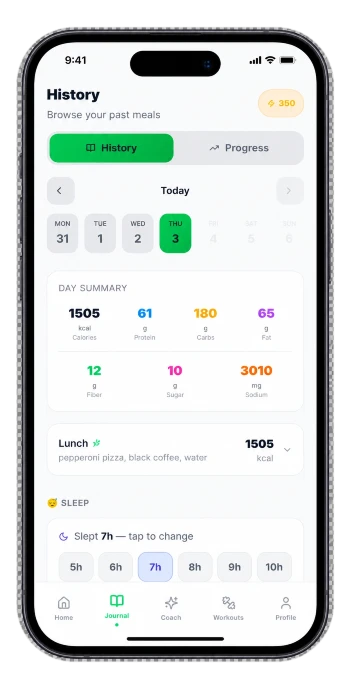
With the food logger in Navilo Health you snap a photo or say what you ate, and your calories, protein, carbs and fat add up for you.
Common Mistakes When Counting Calories From Photos
Trusting every estimate without looking. A quick check catches obvious errors, like a portion that's half what you ate.
Only logging "proper" meals. Snacks, drinks and bites while cooking can easily add 300 to 500 calories a day. If it went in your mouth, it counts.
Forgetting cooking fat. See above.
Never updating your target. Your calorie needs drop as you lose weight, because a smaller body uses less energy. A target that worked at 90 kg may stall you at 80 kg. Run the calorie calculator again every 4 to 5 kg of change.
Chasing perfect numbers. Some people get so focused on precision that they start dreading meals. If logging makes you anxious, loosen up. Roughly right is good enough.
Quitting after one "bad" day. Everyone has days where they go well over. Log it anyway and carry on. A gap in the log hides the information you need most.
Who Should Be Careful With Calorie Counting
If you have a history of disordered eating, or find that tracking food makes you anxious, obsessive or guilty, please talk to your doctor or a specialist before starting. There are other ways to work on your health that don't involve numbers.
If you're pregnant or breastfeeding, have diabetes, take medication that affects your appetite or blood sugar, or have any long-term health condition, check any calorie target with your doctor first. The same goes for teenagers. Calorie calculators are built for healthy adults.
A lower target isn't a better one. Very low intakes are hard to keep up and make it harder to get enough nutrients, so don't go far below your needs without medical supervision. For reference, the NHS uses about 2,000 calories a day for women and 2,500 for men as rough averages.
The Bottom Line
Photo counting isn't precise, but it's quick enough that people keep doing it. Set a target with a calorie calculator, photograph what you eat, fix the portions, add the oil and drinks, and judge by weekly averages. Adjust after a few weeks if your weight isn't doing what you expected.
Frequently asked questions
How accurate is counting calories from a photo?
It varies a lot. A 2023 review of 52 studies on AI photo estimates found average calorie errors anywhere from under 1 percent to about 38 percent, with simple single foods doing best. Mixed dishes, sauces and hidden oil make it less accurate. Checking and adjusting the portion before saving helps.
Do I still need a calorie calculator if I log meals with photos?
Yes. A photo tells you what you ate. A calorie calculator tells you how much you should eat. Without a target, a daily total of 2,100 calories is just a number with nothing to compare it to.
Is photo logging better than weighing food?
Weighing is more precise. Photo logging is faster and much easier to stick with. For most people, the method you'll actually use every day for months beats the perfect method you give up on after a week.
What foods are hardest to estimate from a photo?
Anything where the calories are hidden: cooking oil, butter, dressings, creamy sauces, cheese melted into a dish, fried food, smoothies and drinks. Soups and stews are tricky too, because you cannot see what is under the surface.
Should I photograph food before or after eating?
Before. You want the full portion on the plate. If you go back for seconds, take another photo or add it to the same meal afterwards.
How often should I recalculate my calorie target?
Your energy needs fall as you lose weight, so a target that worked at the start will slowly stop working. A practical rule of thumb is to recheck it every 4 to 5 kg of change or every couple of months, and whenever your activity level changes a lot, for example a new job, a new training plan or an injury.
Sources
- Lichtman SW, Pisarska K, Berman ER, et al. Discrepancy between self-reported and actual caloric intake and exercise in obese subjects. New England Journal of Medicine, December 1992.
- Mifflin MD, St Jeor ST, Hill LA, et al. A new predictive equation for resting energy expenditure in healthy individuals. American Journal of Clinical Nutrition, February 1990.
- Ho DKN, Tseng SH, Wu MC, et al. Validity of image-based dietary assessment methods: a systematic review and meta-analysis. Clinical Nutrition, 2020.
- Shonkoff E, Cara KC, Pei XA, et al. AI-based digital image dietary assessment methods compared to humans and ground truth: a systematic review. Annals of Medicine, 2023.
- Roza AM, Shizgal HM. The Harris Benedict equation reevaluated: resting energy requirements and the body cell mass. American Journal of Clinical Nutrition, July 1984.
- Hall KD. What is the required energy deficit per unit weight loss?. International Journal of Obesity, March 2008.
- Centers for Disease Control and Prevention. Steps for Losing Weight. CDC, accessed October 2026.
- National Institute of Diabetes and Digestive and Kidney Diseases. Body Weight Planner. NIDDK, accessed October 2026.
- Iraki J, Fitschen P, Espinar S, Helms E. Nutrition recommendations for bodybuilders in the off-season: a narrative review. Sports, June 2019.
- NHS. Understanding calories. NHS, accessed October 2026.
- U.S. Department of Agriculture, Agricultural Research Service. FoodData Central. USDA, accessed October 2026.
Spotted a mistake or an out-of-date number? Tell me and I'll check it.
Report an errorThis article is general information, not medical advice. Talk to a doctor before big changes to your diet or training.
Keep reading
Weight
Weight Loss: How to Burn Body Fat and Keep It Off
A research-led guide to weight loss that actually lasts: how a calorie deficit works, what to eat, how to train, and when to talk to a doctor first.
Training
How to Gain Muscle: The Complete Guide to Building Muscle
How muscle actually grows, and the training, food and sleep habits that make it happen, explained without the gym-bro myths.
Nutrition
How to Choose the Best AI Food Tracker for You
How AI food trackers work, how accurate photo calorie estimates are, and what to check on iPhone or Android before you choose one. Includes a meal calculator.