
Gym Warm Up Exercises: Warm Ups for a Workout
A simple gym warm-up you can actually stick to: a full-body routine, upper and lower body versions, and the best warm-up exercises for each.
By Pierre Klasson · Last updated 29 October 2026 · 18 min read
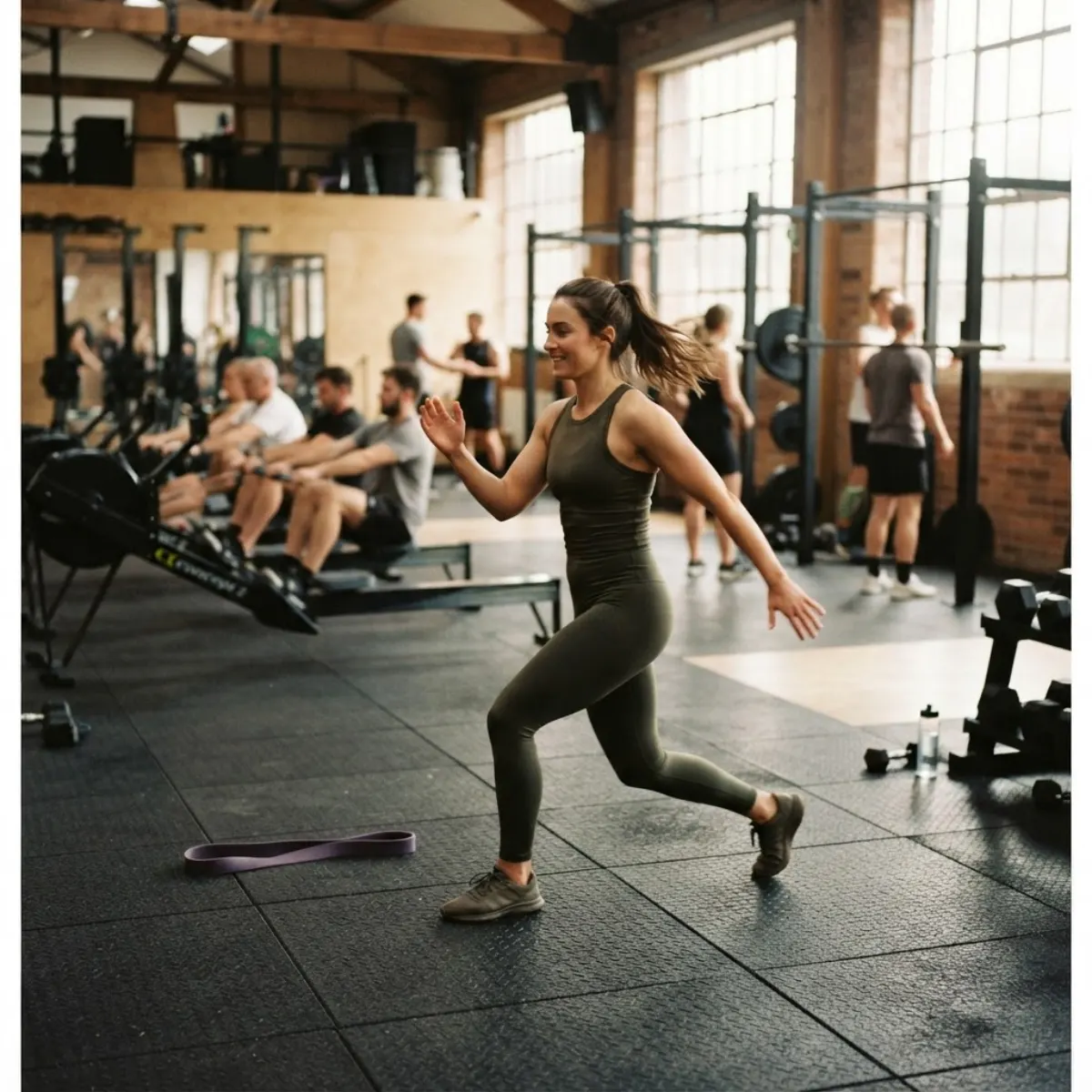
Most of us have done it. You walk into the gym, load the bar and go straight into your first heavy set. Your knees feel stiff, your shoulders feel tight, and the weight feels heavier than it did last week. Maybe something twinges a bit, and you spend the rest of the session being careful with it.
A warm-up fixes most of that, and it doesn't take long. Ten minutes is enough for most sessions. I used to skip it completely because I thought it was wasted time. These days I wouldn't touch a heavy squat without one, and my first working sets feel a lot better for it.
This guide gives you a routine you can use every time, separate versions for upper and lower body days, a library of exercises to pick from, and a simple plan for warm-up sets. It's written for anyone who uses a gym, whether you've been lifting for a month or ten years.
Why warming up is worth it
Your muscles work better when they're warm. That's not just a saying. When you move, your body temperature goes up a little, and warmer muscles contract faster and with more force. Nerve signals travel faster too, so the message from your brain to your muscles gets there a bit quicker.
Easy movement also sends more blood to the muscles you're about to use. That brings oxygen and helps them get ready for harder work. Joints feel smoother as well, because moving them spreads the fluid that keeps them lubricated. Anyone who's felt their knees go from creaky to fine after a few minutes on the bike knows what that feels like.
The research backs this up. A large review of warm-up studies found that warming up improved performance in most of the tests they looked at, from strength and power to sprinting. It didn't help in every single case, but it rarely hurt.
There's a mental side too, and I think people underrate it. A few minutes of warm-up gives you time to switch off from work, think about your session and practise the movement before the weight gets heavy. You notice how your body feels that day. If your lower back is grumpy, you'll find out during warm-up squats rather than halfway through a heavy set.
It can also lower your risk of strains. A review of the trials on this found that most of them showed fewer injuries in people who warmed up, though the studies weren't perfect and no warm-up makes you injury-proof. Sensible weights, good technique and enough recovery between sessions still do most of the work there. Think of a warm-up as one part of looking after yourself, not a magic shield.
What happens if you skip it
Plenty of people skip their warm-up and never get hurt, so it's fair to ask whether it really matters. Here's what you tend to notice when you don't bother.
Your first sets feel heavier and clumsier than they should. You might cut your range of motion short without realising it, like squatting a bit higher or not lowering the bar fully on a bench press. That means you're not training the way you think you are.
You also give yourself less margin for error. A cold muscle that suddenly has to work hard is more likely to complain. That's especially true for fast or heavy movements, and for joints that move in lots of directions like the shoulder and hip.
And honestly, the session is less enjoyable. Spending the first ten minutes of your workout feeling stiff isn't much fun. A short warm-up turns those minutes into useful ones.
How a good warm-up is built
Think of it as three short steps. Each one is a bit more specific than the last, so you go from general to exactly what you're about to do.
1. Get warm (3 to 5 minutes). Rowing machine, bike, cross-trainer, brisk incline walk or skipping. Keep it easy. Mayo Clinic suggests starting slow and building up gradually. You should be able to talk in full sentences, and by the end you should feel slightly warmer and be breathing a little faster. A light sweat is fine. Being out of breath isn't the goal.
2. Move the joints you'll use (3 to 5 minutes). Dynamic stretches and light bodyweight moves take your hips, shoulders, ankles and back through the range you'll need. Do around 8 to 10 reps of each, slowly and with control. Start with smaller movements and make them bigger as you go.
3. Practise the main lift (2 to 5 minutes). Do lighter sets of your first exercise and build up toward your working weight. This is the step people skip most, and it's the one that makes your working sets feel solid. It's also the most specific practice you can get.
On a heavy day, when it's cold or after a long day at a desk, take the longer end of each range. On a light day you can keep it to 5 or 6 minutes in total. The aim isn't to tick off a fixed list. It's to walk up to your first working set feeling ready.
Not sure what to do today? Pick your session below and it'll put a routine together for you.
🔥 Build your warm-up
Pick what you're training and how much time you've got.
Today's session
Time for the warm-up
- Rowing machine or bike: 4 minutes, easy
- Cat-cow: 8 slow reps
- World's greatest stretch: 4 per side
- Leg swings: 10 each way, per leg
- Arm circles: 10 each way
- Bodyweight squats: 10 reps
- Warm-up sets of your first lift
- • 40 to 50% of working weight, 8 to 10 reps
- • 60 to 70% of working weight, 4 to 5 reps
- • 80 to 85% of working weight, 2 to 3 reps
Keep it easy. You should feel warm, not tired. Stop if anything hurts sharply.
How long should a warm-up be?
For most gym sessions, 5 to 15 minutes is the sweet spot. Shorter than that and you probably haven't warmed up much. Much longer and you're eating into your training time and energy.
A few things should push you toward the longer end:
- Heavy lifting days. If you're working with weights close to your max, give yourself more build-up sets.
- Cold weather or a cold gym. Your body takes longer to warm up when the room is chilly.
- Early mornings. Your spine and joints tend to feel stiffer soon after you wake up.
- Long days sitting. Hours at a desk leave your hips and upper back tight.
- Getting older. Many people find they need a little more time to feel loose as they age. If you're curious how your mobility and balance are holding up, try the sit-and-rise test. It takes a minute.
- Coming back after a break or an injury. Ease in gently.
A light session, a warm summer afternoon or a second workout later in the day can get by with less. Listen to how you feel. If you still feel stiff after your usual routine, add a few more minutes.
Dynamic vs static stretching
This is where a lot of the confusion comes from, so it's worth explaining properly.
Dynamic stretches keep you moving. Leg swings, arm circles, walking lunges and hip circles are all examples. You take a joint through its range of motion over and over, a bit further each time.
Static stretches mean holding one position still, like touching your toes or pulling your heel to your bum and staying there for 30 seconds or more.
Research suggests that long static holds right before training can make muscles slightly weaker and less explosive for a short while. That effect seems to be strongest with holds of 60 seconds or more. Short holds of under about 30 seconds seem to make little difference, especially when you follow them with dynamic work and warm-up sets. Dynamic stretching, on the other hand, tends to help performance or at least not hurt it. Cleveland Clinic explains the difference well if you want to read more, and Harvard Health has a short list of dynamic stretches worth trying.
So the simple rule is this: keep moving before you lift and do your longer stretches after your workout, when your muscles are warm and you're not about to lift anything heavy.
There's one exception. If one area feels really tight and is stopping you from getting into position, like your calves before squats or your chest before overhead pressing, a short hold of 20 to 30 seconds is fine. Follow it with a few dynamic reps so you don't feel flat.
Foam rolling before training
Foam rolling is popular in many gyms, and it has a place in a warm-up as long as you keep it short. A minute or two on areas that feel tight, like your upper back, quads or calves, can make them feel looser for a while.
What it won't do is replace actually warming up. Lying on a roller doesn't raise your body temperature much. Use it as a quick extra between your cardio and your dynamic moves if you like it, and skip it if you don't. Either way is fine.
Full-body warm-up routine
Use this before a full-body session, or any time you're not sure what to do. It takes about 10 minutes and covers every major joint.
- Rowing machine or bike: 4 minutes at an easy pace, building up a little in the last minute. The rower is great because it uses both your legs and upper body.
- Cat-cow: 8 slow reps on hands and knees. Round your back up toward the ceiling, then let your belly drop and lift your chest. This loosens your whole spine.
- World's greatest stretch: 4 reps per side. Step into a long lunge, put both hands on the floor inside your front foot, then rotate the arm closest to your front leg up toward the ceiling. Follow your hand with your eyes.
- Leg swings: 10 front to back and 10 side to side, per leg. Hold on to a rack or wall for balance, and let the swings get bigger as you go.
- Arm circles: 10 forward and 10 backward, starting small and getting bigger.
- Bodyweight squats: 10 slow reps, pausing for a second or two at the bottom. Push your knees out and keep your chest up.
- Inchworms: 5 reps. Stand tall, bend down and put your hands on the floor, then walk them out to a plank. Walk them back and stand up.
- Glute bridges: 10 reps lying on your back. Squeeze your glutes at the top and pause for a second.
Then go to your first exercise and do two or three lighter sets before your working weight. If your session starts with a squat, you can cut the squats from step 6 because your warm-up sets will cover it.
Upper body warm-up
Your shoulders are the joint to look after on chest, back and arm days. They move in more directions than any other joint in your body, and that freedom comes with less built-in stability. They really don't like going from cold to a heavy bench press or overhead press.
The other area worth some attention is your upper back. If it's stiff, your shoulders end up doing extra work to make up for it. A few rotations go a long way.
- Easy cardio: 3 minutes on the rower or ski machine. Both use your arms, so they warm up your upper body better than a bike.
- Arm circles: 10 each way, small to big.
- Band pull-aparts: 15 reps. Hold a light band at shoulder height with straight arms and pull it apart until it touches your chest. Squeeze your shoulder blades together at the end.
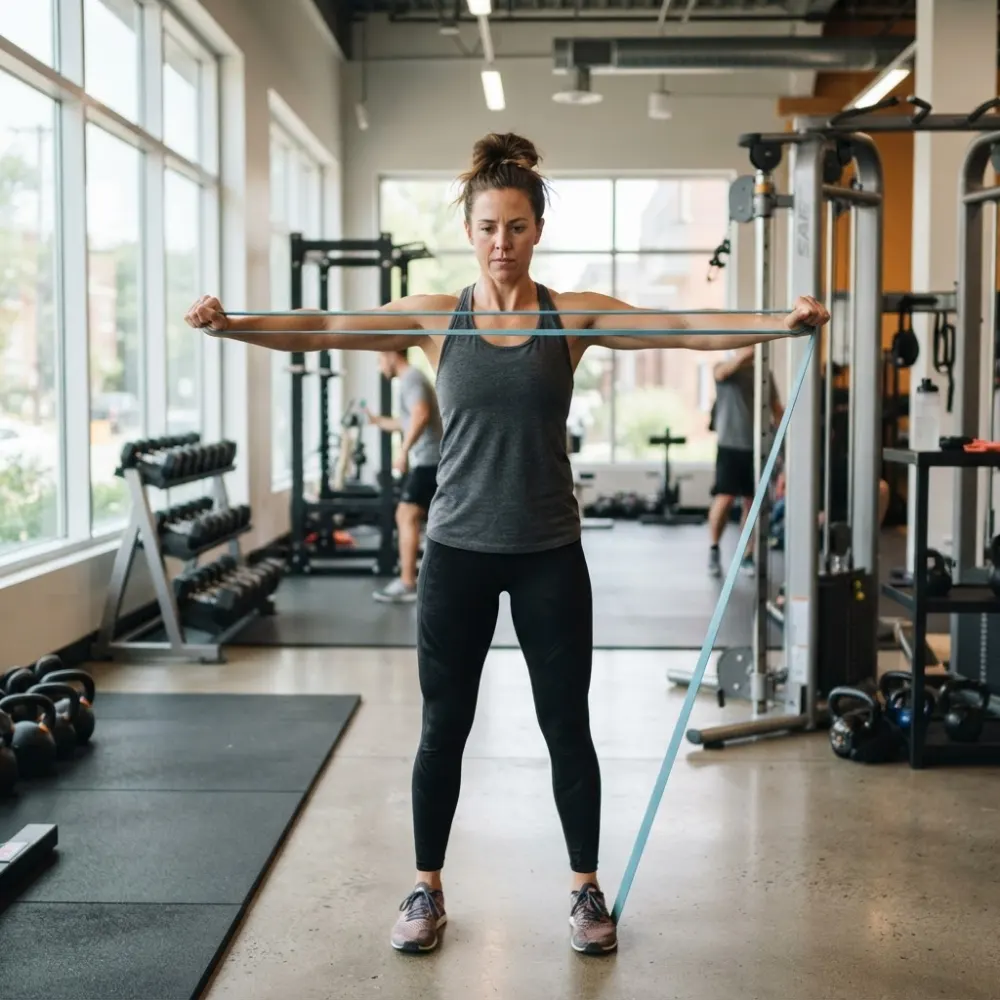 Band pull-apart: keep your arms straight and pull from your shoulder blades.
- Band dislocates: 10 reps. Hold a band or broomstick with a wide grip and lift it over your head and behind you, keeping your arms straight. Widen your grip if it feels tight. Never force it.
- Thoracic rotations: 8 per side. On hands and knees, put one hand behind your head and rotate your elbow up toward the ceiling, then down toward your other hand.
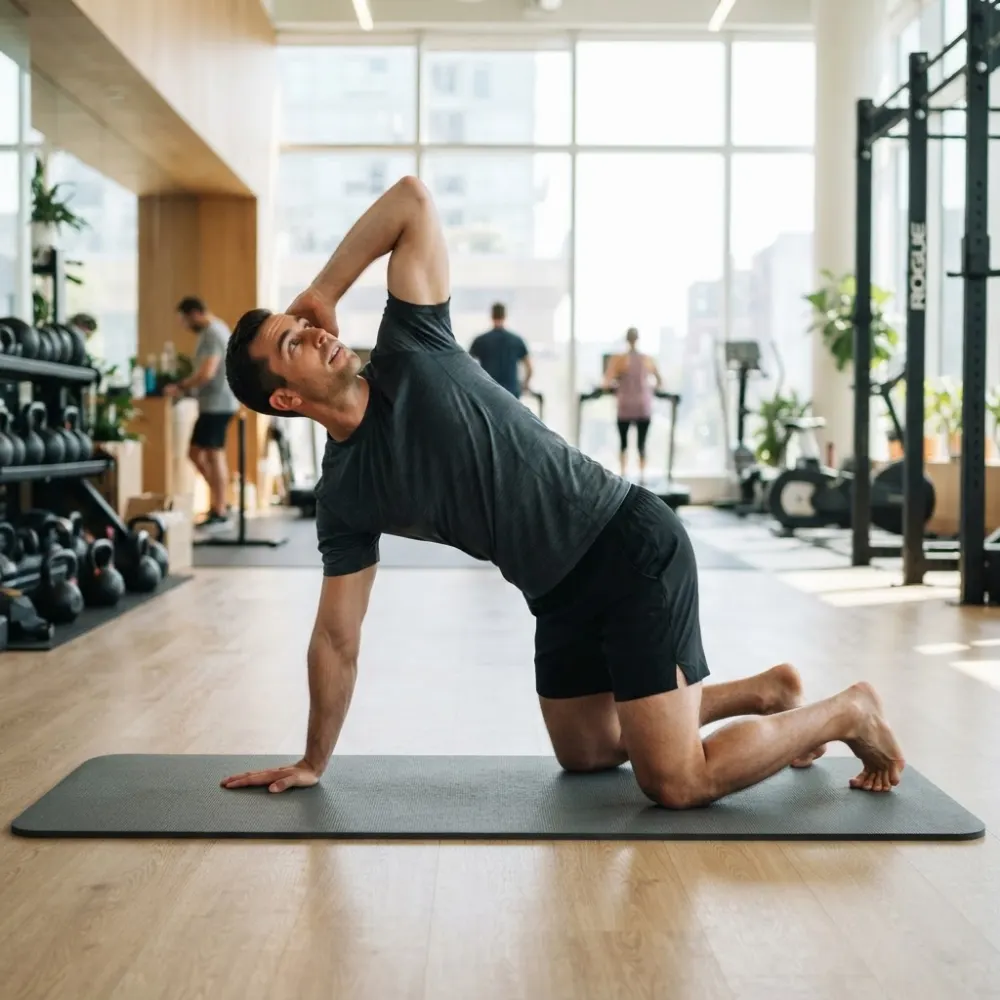 Thoracic rotation: turn from your upper back and follow your elbow with your eyes.
- Wall slides: 10 reps. Stand with your back to a wall, arms in a goalpost shape, and slide them up and down while keeping your back and arms against the wall.
- Scapular push-ups: 10 reps. In a plank, keep your arms straight and let your chest sink between your shoulder blades, then push it away.
- Push-ups or incline push-ups: 8 to 10 easy reps.
Then build up on your first lift. For a bench press, that might be an empty bar for 10, then about half your working weight for 5, then around 75% for 3, then your working sets.
Pull day variation
If your session starts with pull-ups or rows, swap the push-ups for a few slow dead hangs from the pull-up bar (10 to 20 seconds) and a set of light band rows or lat pulldowns. Hanging gives your shoulders a gentle stretch and wakes up your grip.
Overhead pressing variation
Overhead pressing needs good shoulder and upper back mobility. Spend a bit more time on wall slides and thoracic rotations, and add a set of light overhead presses with an empty bar or a pair of small dumbbells before you build up.
Lower body warm-up
Leg days usually need the most warm-up because squats and deadlifts load your whole body. Your hips, knees and ankles all need to move freely, and your back needs to be ready to hold a solid position under load.
- Bike or incline walk: 4 to 5 minutes. The bike is easy on the knees, and an incline walk gets your glutes and calves going.
- Leg swings: 10 front to back and 10 side to side, per leg.
- Walking lunges: 8 per leg. Take a long step, drop your back knee toward the floor and keep your chest up. Add a twist toward your front leg if you like.
- Lateral lunges: 6 per side. Step out wide, sit back into one hip and keep the other leg straight.
- 90/90 hip switches: 8 per side. Sit with both knees bent at 90 degrees, one in front and one to the side, then rotate both knees to the other side.
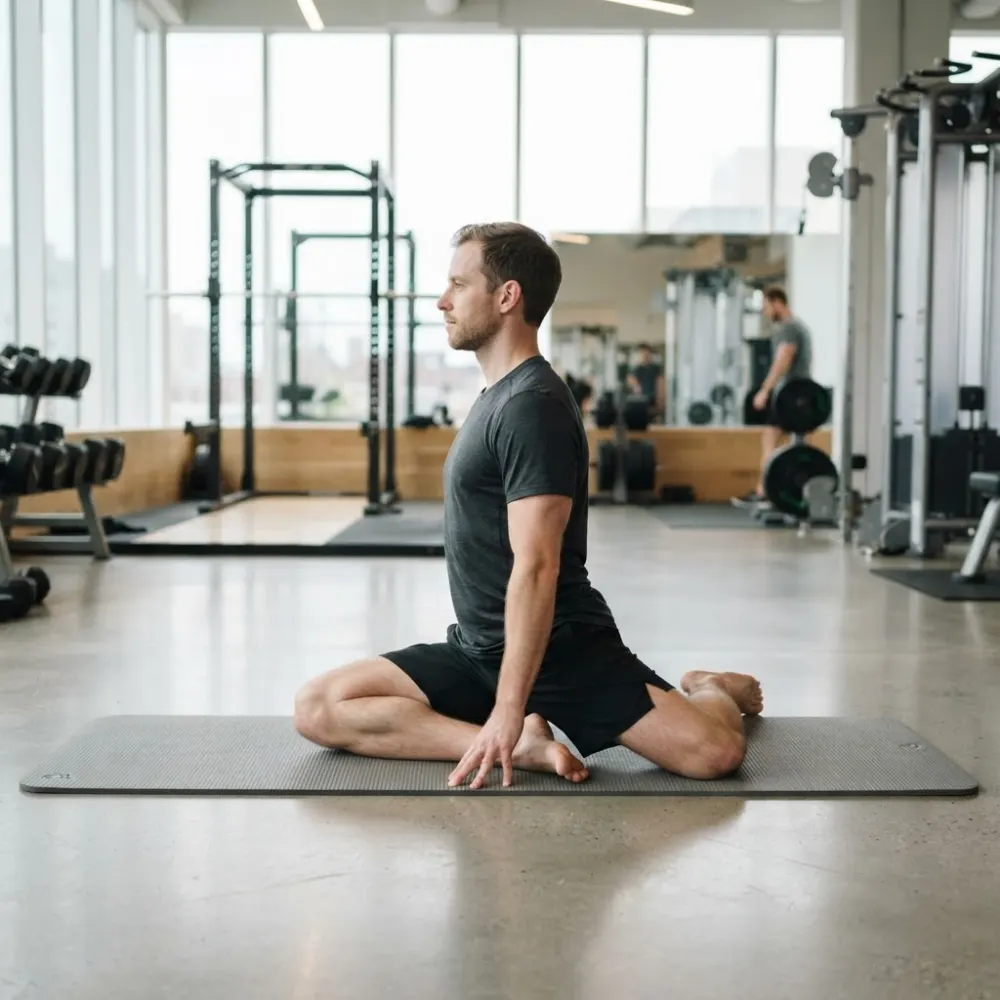 The 90/90 position: sit tall, then swing both knees over to the other side.
- Ankle rocks: 10 per side. Kneel in a half-lunge and push your front knee forward over your toes, keeping your heel down. Stiff ankles are one of the most common reasons squats feel awkward.
- Glute bridges: 12 reps.
- Goblet squats with a light weight: 8 reps, sitting into the bottom for a second or two. The weight in front helps you stay upright and sit deeper.
After that, warm up on your main lift. With squats, three or four build-up sets is normal for heavier weights.
Deadlift day variation
For deadlifts, focus more on your hamstrings and hips. Add a set of light Romanian deadlifts or kettlebell swings before your build-up sets. Both teach you to hinge at the hips and help you feel your hamstrings and glutes working.
Single-leg day variation
If your main lifts are split squats, step-ups or lunges, spend extra time on balance. A few slow reps of each exercise with just your bodyweight, before adding load, help your stabilising muscles switch on.
Warm-up exercise library
Mix and match from this list to build your own routine. Pick one or two from each group that matches the session. Do 8 to 10 reps of each, or around 30 seconds for the cardio moves.
To raise your heart rate
- Rowing machine: great all-rounder for upper and lower body
- Bike: easy on the joints
- Cross-trainer or ski machine
- Skipping, with or without a rope
- Jumping jacks
- Brisk incline walk
For the hips and legs
- Leg swings, front to back and side to side
- Walking lunges, with or without a twist
- Lateral lunges
- Bodyweight or goblet squats
- Glute bridges
- 90/90 hip switches
- Ankle rocks
- Fire hydrants on hands and knees
- Good mornings with no weight or a broomstick
For the shoulders and upper back
- Arm circles
- Band pull-aparts
- Band dislocates
- Wall slides
- Scapular push-ups
- Thoracic rotations
- Dead hangs from a pull-up bar
- Face pulls with a light cable or band
For the whole body
- World's greatest stretch
- Inchworms
- Cat-cow
- Bear crawls
- Dead bugs, which also wake up your core
- Light kettlebell swings
You don't need to do all of them. Four to six moves is plenty for most sessions. Once you find the ones that make you feel good, stick with them. A routine you know by heart is easier to do every time.
Warm-up sets for your first lift
Warm-up sets are just the main exercise done with lighter weight. They let you practise technique, groove the movement and find out how your body feels that day. Nothing else prepares you for a squat quite like squatting.
There's no study that settles the exact numbers here. This is a rule of thumb most coaches use, and it works well for most lifts:
- Set 1: about 40 to 50% of your working weight for 8 to 10 reps
- Set 2: about 60 to 70% for 4 to 5 reps
- Set 3: about 80 to 85% for 2 to 3 reps
- Then your working sets
Here's how that looks if your working weight on the squat is 100 kg:
- Empty bar (20 kg) for 10 reps
- 50 kg for 8 reps
- 70 kg for 4 reps
- 85 kg for 2 reps
- 100 kg for your working sets
Keep the reps low as the weight goes up so you don't tire yourself out before the sets that count. Rest about a minute between warm-up sets. You don't need full rest because the weights are light.
If your working weight is light, two warm-up sets is enough. If you're working up to something very heavy, you might add one more set in the 90% range with a single rep.
Your second and third exercises usually need just one warm-up set, or none, because the muscles are already warm. A new movement that uses different muscles, like going from bench press to squats, deserves a couple of build-up sets again.
Warming up for different kinds of sessions
Not every gym session is a heavy lifting day. Here's how to adjust.
Cardio sessions. Start your run, ride or row at an easy pace for 5 minutes and build up gradually. If you're doing intervals, add two or three short pick-ups at a faster pace before your first hard effort.
HIIT and circuit classes. These start hard and fast, so warm up properly. Do your easy cardio, then a few rounds of the moves you'll do in the class at a slower pace. Jumping, sprinting and quick changes of direction especially need a good warm-up.
Machine-based sessions. Machines guide the movement for you, so you need less mobility work. Easy cardio plus one or two lighter sets on the first machine is usually enough.
Light days and recovery sessions. A few minutes of cardio and some dynamic moves is plenty. The session itself is basically a warm-up.
Common warm-up mistakes
Skipping it because you're short on time. If you only have 30 minutes, a 5-minute warm-up still makes sense. Cut one accessory exercise instead. You'll get more out of the main lifts.
Going too hard. A warm-up shouldn't leave you out of breath or sore. If you're sweating heavily and puffing before your first set, ease off. You want to feel ready, not tired.
Doing the same thing every day. Ten minutes on the treadmill won't prepare your shoulders for a press. Match the warm-up to the muscles you're training.
Only stretching. Stretching on its own doesn't raise your body temperature much. Do some easy cardio first.
Holding long stretches before heavy lifts. Save the 60-second holds for later.
Skipping warm-up sets. Bodyweight moves are good, but they don't replace practising the actual lift with lighter weight.
Copying a 30-minute routine from social media. Some elaborate warm-ups look impressive but leave you with less energy for the real work. Keep it simple.
How to cool down after your workout
A cool-down isn't strictly necessary. One review found it doesn't do much for next-day soreness or recovery, but a few minutes of it can still help you feel better after a hard session. Walk or ride easy for 3 to 5 minutes to bring your heart rate down gradually.
This is also the best time for static stretching if you want to work on flexibility. Your muscles are warm, and you're not about to lift anything. Hold each stretch for 20 to 40 seconds and breathe slowly. Focus on the areas you trained and any spots that always feel tight.
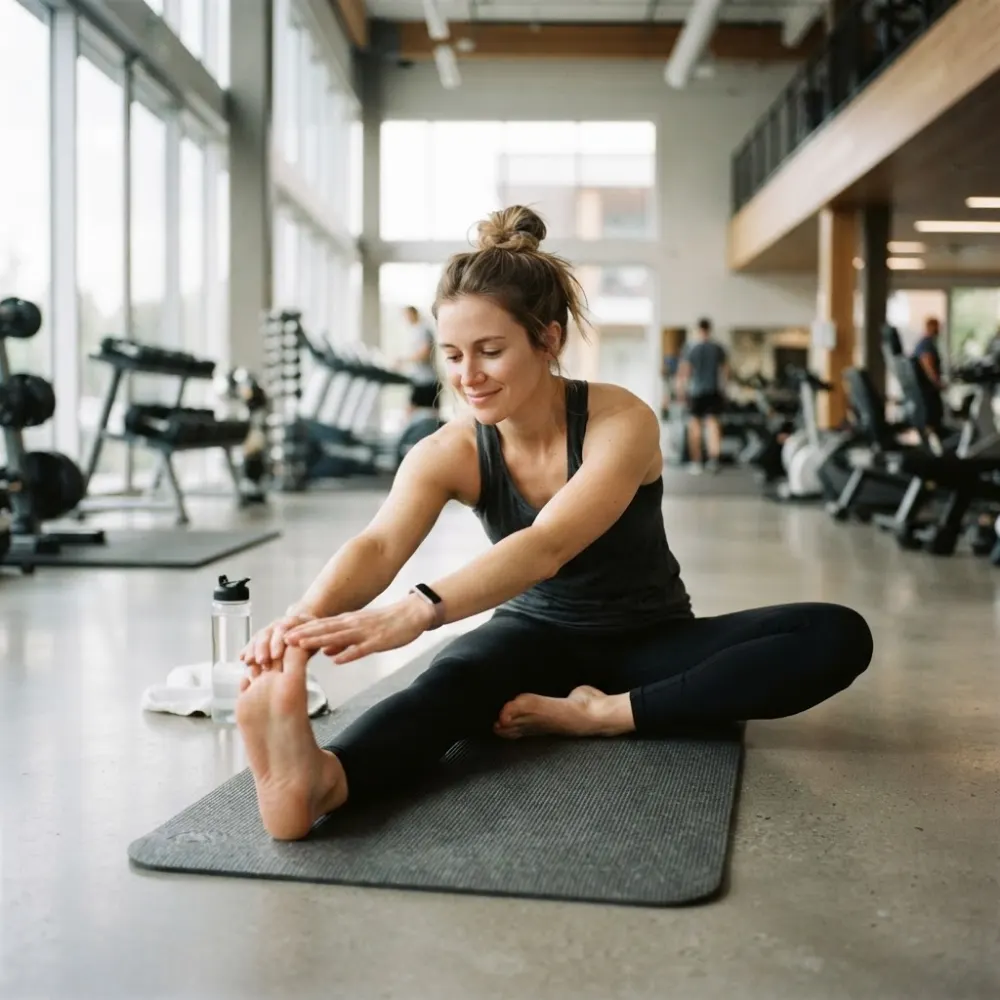 After your session is the time for slow holds like this seated hamstring stretch.
Safety: when to take extra care
A warm-up is a great time to notice how you feel. Mild stiffness that eases as you move is normal and nothing to worry about. Sharp pain, pain that gets worse as you warm up, or pain in one specific joint isn't something to push through. Swap to a different exercise or stop and get it checked.
Talk to a doctor or physiotherapist before starting a new routine if you have a heart condition, high blood pressure, a recent injury or surgery, joint problems, or if you're pregnant. They can tell you which movements to avoid and how to adapt the rest.
If you get chest pain, dizziness, faintness or unusual shortness of breath during any part of your session, stop right away and get medical help if it doesn't settle quickly.
Putting it into practice
You don't need to follow every step perfectly. Pick the routine that matches today's session, keep it to about 10 minutes, and do a few lighter sets before your first lift. If you're not sure, use the full-body routine. It works for almost anything.
Try it for a couple of weeks. It'll start to feel automatic, and you'll probably notice that your first working sets feel smoother and stronger. That's the whole point.
If you're training to build muscle, our guide on how to gain muscle covers what to do once you're warm: training volume, protein and recovery. Its calorie surplus calculator shows how much extra to eat while you build. And for small daily changes that support your training, take a look at our healthy life hacks.
Frequently asked questions
How long should a gym warm-up be?
Usually 5 to 15 minutes. Shorter on a light day or when it is warm, longer on a heavy lifting day, early in the morning or if you have been sitting all day.
Should I stretch before lifting weights?
Moving stretches like leg swings and arm circles are a good fit. Long static holds of a minute or more right before heavy lifting can make you a little weaker for a short while, so save those for after your session.
Is walking on the treadmill enough of a warm-up?
It's a good start because it raises your heart rate and body temperature. But it doesn't prepare your shoulders or hips for lifting, so follow it with a few dynamic moves and some lighter sets.
How many warm-up sets should I do?
For your first big lift, two to four lighter sets that build up to your working weight is plenty. Later exercises for the same muscles usually need one warm-up set, or none.
Can a warm-up prevent injuries?
It can lower the risk, but it can't remove it. Good technique, sensible weights and enough recovery matter just as much.
Do I need to warm up before cardio?
Yes, but it can be simple. Start your run, ride or row at an easy pace for 5 minutes and build up from there.
Should I warm up differently in the morning?
Give yourself a few extra minutes. Your spine and joints tend to feel stiffer soon after waking, so spend a little longer on easy cardio and mobility before loading the bar.
Do warm-up sets count toward my training volume?
Not really. They're light enough that they don't add much training stimulus. Count your working sets when you plan your week, and log warm-ups separately if your tracker allows it.
Sources
- Fradkin AJ, Zazryn TR, Smoliga JM. Effects of warming-up on physical performance: a systematic review with meta-analysis. Journal of Strength and Conditioning Research, January 2010.
- Mayo Clinic Staff. Aerobic exercise: How to warm up and cool down. Mayo Clinic, August 2023.
- Cleveland Clinic, with Anne Rex, DO. Dynamic vs. Static Stretching: Is One Better?. Cleveland Clinic.
- Harvard Health Publishing. Dynamic Stretches. Harvard Medical School.
- Fradkin AJ, Gabbe BJ, Cameron PA. Does warming up prevent injury in sport? The evidence from randomised controlled trials?. Journal of Science and Medicine in Sport, June 2006.
- Van Hooren B, Peake JM. Do we need a cool-down after exercise? A narrative review of the psychophysiological effects and the effects on performance, injuries and the long-term adaptive response. Sports Medicine, July 2018.
Spotted a mistake or an out-of-date number? Tell me and I'll check it.
Report an errorThis article is general information, not medical advice. Talk to a doctor before big changes to your diet or training.
Know someone who'd like this one?
Keep reading

Training
How to Gain Muscle: The Complete Guide to Building Muscle
How muscle actually grows, and the training, food and sleep habits that make it happen, explained without the gym-bro myths.

Habits
17 Healthy Life Hacks That Actually Make a Difference
Simple everyday health hacks for sleep, food, movement and stress, with why each one helps, what the research says and how big the benefit really is.
Keep reading
More guides in the same topic.